The best grass for Dubai is a warm-season grass that tolerates heat, salt and drought. For most sunny villa lawns that means seashore paspalum or bermuda grass. If your lawn sits in shade from walls or trees for part of the day, zoysia is usually the safer pick.
No real lawn in Dubai looks after itself, though. Summer heat, sandy soil and salty water mean the grass you choose matters less than how well it is watered, mowed and fed. And in some spots, such as deep shade, small courtyards or rentals, artificial grass is simply the more practical answer.
Why most grasses struggle in Dubai
Dubai combines four problems that cool-climate lawn grasses can't handle: extreme heat, high evaporation, poor sandy soil and water that often carries salt.
Summer daytime temperatures on the UAE coast typically sit between 41°C and 43°C at the peak of the season, according to Khaleej Times reporting on the UAE's peak summer temperatures. Coastal gardens also deal with humidity and salt spray.
Sandy soil adds to the problem because it holds very little water or nutrients. Water drains through quickly, so roots dry out fast and fertiliser washes away. That is why a Dubai lawn needs regular, deep irrigation and light, frequent feeding rather than the occasional watering a lawn gets in cooler countries.
Cool-season grasses such as ryegrass and fescue, which are common in Europe, usually struggle in a Gulf summer. The grasses that do well here are warm-season types that grow strongest in heat.
The best grass types for Dubai lawns compared
Paspalum, bermuda and zoysia do most of the work in UAE gardens, and St. Augustine is an option for shade. The table uses ratings from the University of Florida's guide to selecting a warm-season lawn grass, which compares these species in a hot, humid, salt-affected climate.
| Grass | Salt tolerance | Drought tolerance | Shade tolerance | Wear tolerance | Best for |
|---|---|---|---|---|---|
| Seashore paspalum | Excellent | Good | Poor | Good to excellent | Sunny lawns, coastal villas, salty or recycled water |
| Bermuda | Good | Excellent | Poor | Excellent | Sunny lawns with children, pets and heavy foot traffic |
| Zoysia | Good | Excellent | Good to excellent (depends on variety) | Good to excellent | Gardens with part shade from walls, buildings or trees |
| St. Augustine | Good | Good | Good to excellent (depends on variety) | Poor to fair | Shaded areas with light use |
Seashore paspalum
Seashore paspalum is the most salt-tolerant of the common lawn grasses. The University of Georgia's turfgrass team notes that it is often used on golf courses with salty soil or irrigated with brackish water.
That matters in Dubai, where coastal gardens face salt spray and salt can build up in sandy soil as irrigation water evaporates in the heat. Paspalum also has a fine, bright green look that many people want for a front lawn.
Main limitation: paspalum needs full sun. It thins out quickly under trees or beside high boundary walls.
Bermuda grass
Bermuda is the tough, hard-wearing option. It has excellent drought and wear tolerance, so it recovers well when children play on it every day or a dog runs the same path along the fence.
Hybrid bermuda varieties are usually planted from sod or sprigs rather than seed, and they look best when mowed short. The trade-off is upkeep: bermuda grows fast in summer, needs frequent mowing, and creeps into flower beds unless you keep a clear edge.
Main limitation: like paspalum, bermuda has poor shade tolerance.
Zoysia
Zoysia is the grass to consider when sun is limited. University of Florida researchers rate many zoysia varieties good to excellent in shade, with fine-leaved types generally doing better than coarse ones. It also handles heat and drought well.
Zoysia grows more slowly than bermuda, so it needs less mowing but takes longer to fill in bare patches. Ask your supplier which variety they are offering, because shade tolerance differs between varieties.
What about shade from walls and trees?
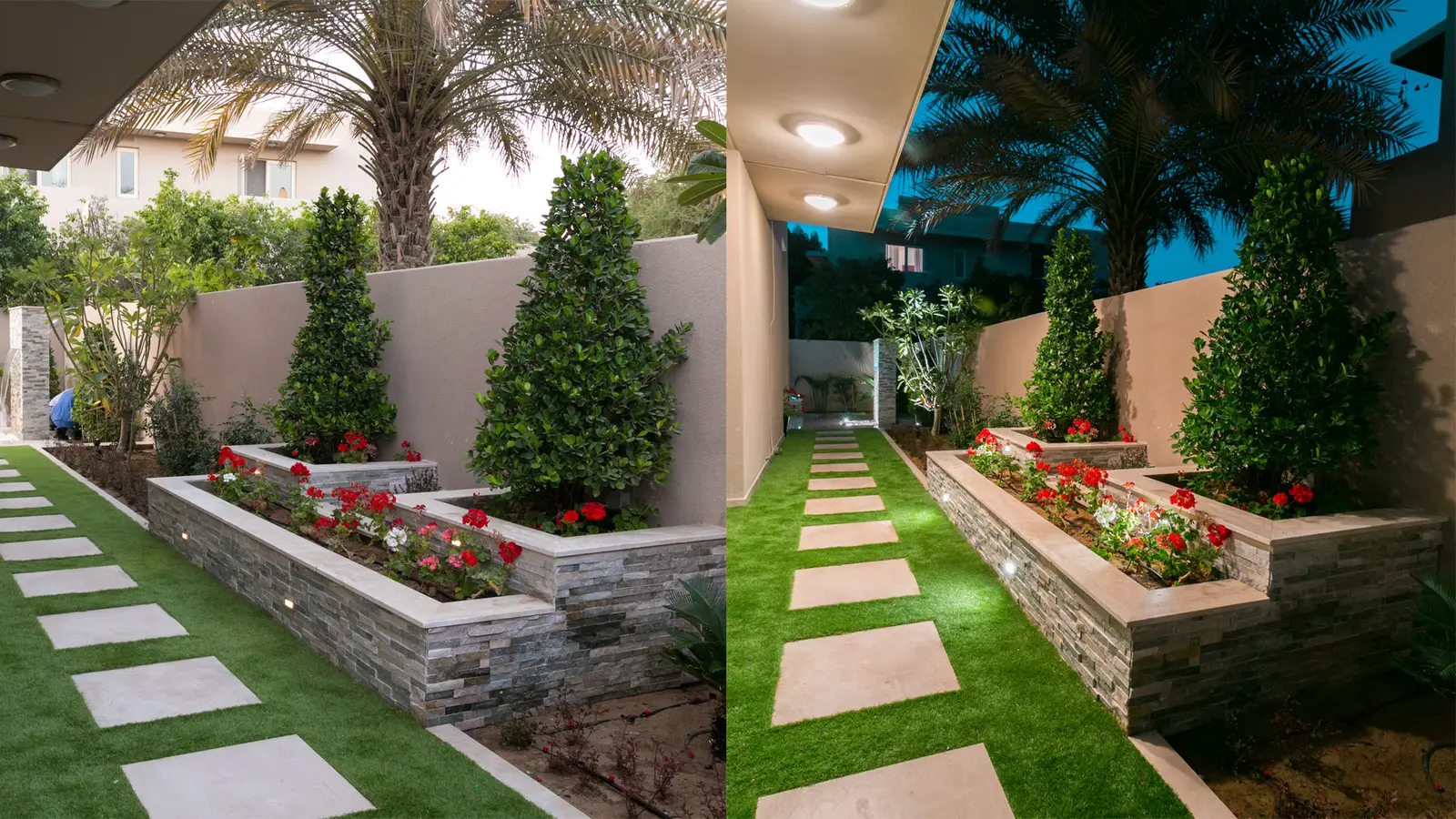
Villa gardens often have narrow side strips shaded by high walls for most of the day. Zoysia or a shade-tolerant St. Augustine variety can work in part shade, but no lawn grass thrives in deep shade. In those spots, paving, ground covers or artificial grass usually give a better result than repeatedly replanting real grass.
How to grow grass in Dubai, step by step
A healthy Dubai lawn starts with good preparation, because sandy soil and summer heat leave little room for mistakes.
- Plan for sun. Watch the area for a full day and note how many hours of direct sun it gets. Choose paspalum or bermuda for full sun and zoysia for part shade.
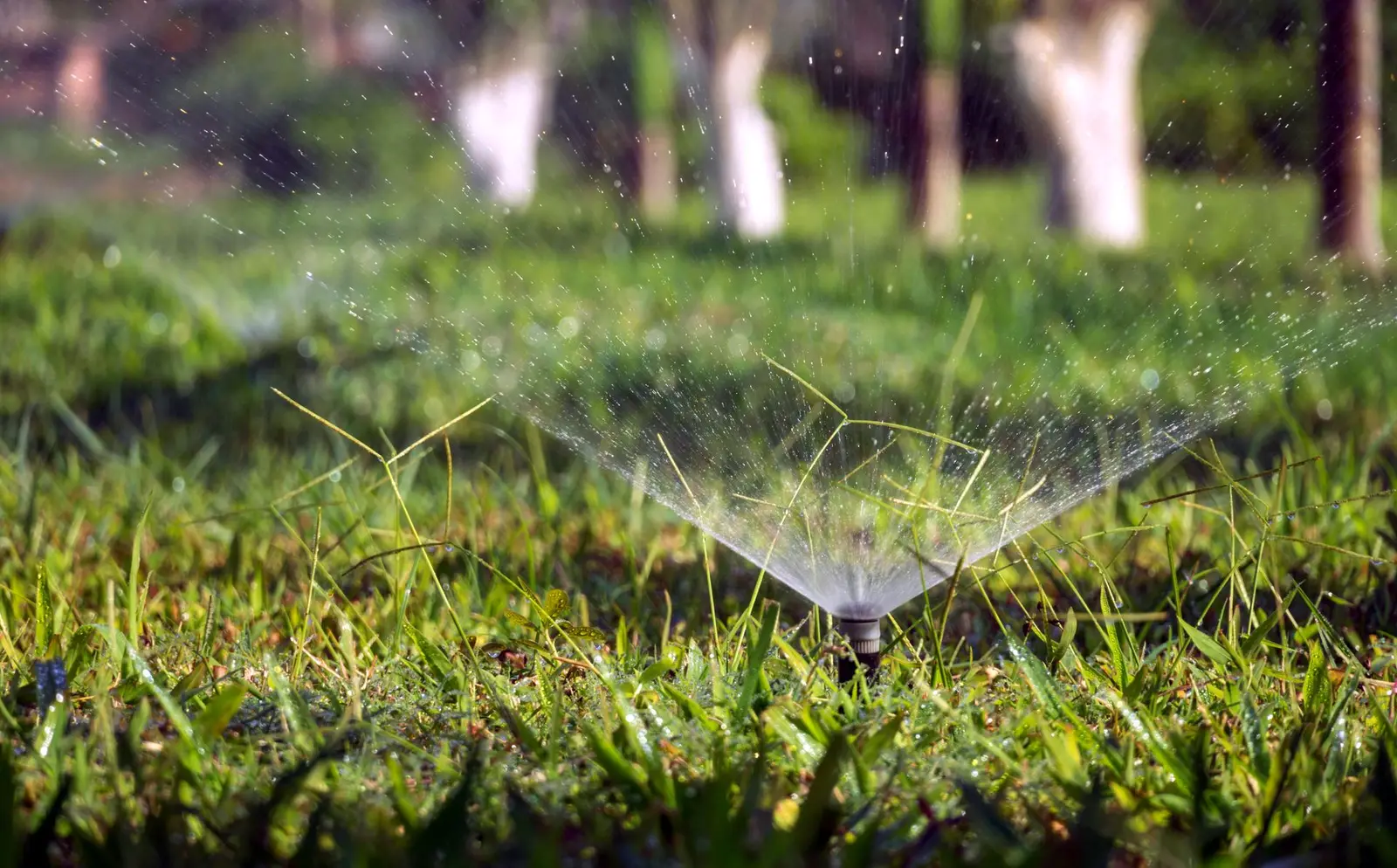
- Install irrigation first. Pop-up sprinklers are the usual choice for lawns because they spread water evenly. Lay pipes and test coverage before any grass goes down, since fixing pipes later means lifting turf. Our garden irrigation guide for Dubai explains sprinklers, zoning and controllers in more detail.
- Prepare the soil. Clear stones and debris, then mix in good-quality soil or compost so the sand holds more water and nutrients. Level the area so water doesn't pool in low spots.
- Choose sod or sprigs. Sod (rolls of ready-grown grass) gives an instant lawn. Sprigs (small pieces of stem and root) can cost less but take weeks to cover the ground.
- Time the planting. Warm-season grasses root best in warm soil, so avoid the coolest weeks of winter and the peak summer heat. Autumn or spring, once the soil is warm, gives roots time to establish. Confirm the best timing for your grass variety with your turf supplier.
- Water little and often at first. New sod needs its top layer kept moist until it roots into the soil below. Once a gentle tug no longer lifts the turf, switch to deeper, less frequent watering.
What is a natural grass carpet?
"Natural grass carpet" is a common Dubai term for sod: real grass grown on a turf farm, cut with a thin layer of soil and delivered in rolls. It is living grass, not a synthetic product. It looks finished on the day it is laid but behaves like any real lawn afterwards, so it needs the same watering, mowing and feeding.
How to keep a lawn alive in the Dubai summer
Summer lawn failures in Dubai usually come down to watering, not grass type. Three habits matter most: watering at the right time, mowing at the right height, and feeding lightly.
When and how much to water
Water in the early morning, before the sun gets strong. University of Florida guidance on watering warm-season lawns explains that daytime watering wastes water through evaporation, while watering in late afternoon can keep leaves wet longer and encourage disease.
The same guidance suggests applying about 13 to 19 mm of water per session, enough to wet the root zone without runoff. Light, frequent sprinkling keeps roots shallow, which makes the lawn more likely to burn in a heatwave.
In practice, sandy Dubai soil dries out much faster than the Florida soils those figures were written for, so summer schedules here often need more sessions per week than in winter. Rather than guessing, watch the grass for signs of thirst:
- leaf blades folding in half lengthwise;
- a blue-grey tint instead of green;
- footprints that stay visible long after you walk across the lawn.
If you see these signs in the afternoon, the lawn needs more water at the next morning cycle. If the lawn stays soggy or grows mushrooms, cut back.
Action tip: check your irrigation controller at the start of each season. A schedule set in March is usually too short for August and too long for December, which wastes water and money on your DEWA bill.
Mowing height and frequency
Mow often enough that you never remove more than one-third of the leaf blade in one cut. This rule from the University of Florida's guide to mowing warm-season lawns protects the grass from shock, which is especially important in summer heat.
- Seashore paspalum: about 25 to 50 mm, according to the University of Georgia.
- Bermuda: about 13 to 38 mm, according to the University of Florida guide.
- Zoysia: the University of Florida guide gives about 50 to 63 mm for coarse types; finer-leaved types are usually kept shorter.
In summer, keep the lawn towards the top of its range. Taller blades shade the soil and roots, which helps the grass hold on to moisture. Keep mower blades sharp, because torn leaf tips turn brown and lose water faster.
You can usually leave short clippings on the lawn. They break down and return nutrients to the soil, which helps in sandy ground.
Feeding
Warm-season grasses need regular feeding to stay green, and sandy soil can't store many nutrients. Small, regular feeds with a slow-release lawn fertiliser work better than one heavy dose that washes past the roots.
As a guide, the University of Georgia gives 2 to 5 pounds of fertiliser per 1,000 square feet per year for seashore paspalum, without specifying the nutrient. That is roughly 1 to 2.5 kg per 100 m². Treat it as a rough guide, follow the product label for each feed, and avoid heavy feeding during the hottest weeks, when grass is already under stress.
Common lawn problems in Dubai and what causes them
Most lawn problems in Dubai have a short list of likely causes. Check these before you replace grass.
| What you see | Likely cause | What to check |
|---|---|---|
| Dry brown patches in a regular pattern | Uneven sprinkler coverage | Run each zone and look for blocked, tilted or broken sprinkler heads |
| Whole lawn dull and blue-grey | Not enough water for the season | Controller run times and start times |
| Thin, patchy grass near walls or trees | Too much shade for the grass type | Hours of direct sun; consider zoysia or a non-grass surface |
| Yellowing despite regular watering | Low nutrients, or too much water | Feeding schedule and whether the soil stays soggy |
| Brown, ragged leaf tips after mowing | Blunt blades or cutting too low | Mower blade condition and mowing height |
| Grass spreading into beds and paths | Running grass with no edge | Fit a solid border between lawn and beds |
Natural grass in Dubai vs artificial grass
Real grass and artificial grass each win in different situations. This table covers the points that matter most for a Dubai villa.
| Factor | Natural grass | Artificial grass |
|---|---|---|
| Water | Needs regular irrigation all year, most in summer | No irrigation; occasional rinsing for dust and pets |
| Upkeep | Mowing, edging, feeding, weed and irrigation checks | Brushing, rinsing, clearing leaves |
| Surface heat in direct sun | Stays much cooler | Can become very hot |
| Shade | Most grasses thin out in shade | Unaffected by shade |
| Upfront cost | Varies with grass type, soil work and irrigation | From AED 35 per m² supplied and installed (see grades below) |
| Lifespan | Many years with good care | About 5 to 15 years depending on grade |
| Feel and environment | Soft, living, cools the area around it | Even and green all year, no mud |
How hot does artificial grass get?
Surface heat is the biggest downside of artificial grass in a hot climate. In US tests summarised by the New York State Department of Health, a synthetic sports field at Brigham Young University averaged about 47°C at the surface while natural grass nearby averaged about 26°C. Penn State researchers measured synthetic turf plots averaging roughly 49°C to 63°C on days when the air was only around 26°C to 29°C.
Those tests were on sports fields with rubber infill, not on Dubai lawns, but they show the pattern clearly: synthetic grass heats up far more than real grass in direct sun. Watering only helps briefly. In the BYU test, a surface cooled to about 29°C by watering climbed back to around 73°C within 20 minutes.
In practice, artificial grass in full sun suits evening use, shaded areas or spaces under a pergola. If children or pets will use a sunny lawn during the day, real grass or added shade is the better plan.
Natural grass price in Dubai: what affects the cost
No single price for natural grass applies to every garden, because the total depends on several separate costs:
- the grass variety and whether you lay sod or plant sprigs;
- soil preparation, levelling and any new soil needed;
- irrigation, which can be a significant part of a new lawn;
- ongoing water and maintenance once the lawn is established.
When you compare natural grass suppliers in Dubai, ask each one for an itemised quote that separates these parts. A low price per square metre for turf rolls alone can hide expensive soil and irrigation work.
A short checklist helps you compare offers fairly. Ask which grass variety is being supplied, and whether it is sod or sprigs. Ask who delivers and lays it, what soil preparation and levelling is included, and whether irrigation is part of the quote or priced separately. Also ask how long the grass should take to root and how it should be watered in the first weeks.
When artificial grass makes more sense
Artificial grass is the practical choice when a real lawn would struggle or the upkeep doesn't fit how you use the space. Common examples include:
- shaded side gardens and courtyards where grass keeps thinning;
- small spaces where a mower is awkward, such as the layouts in our small garden ideas for Dubai;
- rooftops, terraces and play areas without irrigation;
- holiday homes and rentals where nobody is around to check the watering in summer;
- pool surrounds, where clippings and mud near the water are a constant nuisance.
NAM Landscaping's artificial grass installation uses four grades, priced per m² supplied and installed. These are indicative starting prices, confirmed in writing after a free site visit:
| Grade | Pile height | Typical lifespan | From (AED per m²) |
|---|---|---|---|
| Economy | About 25 mm | 5 to 7 years | 35 |
| Mid-range | About 35 mm | 7 to 10 years | 50 |
| Premium | About 40 mm | 10 to 15 years | 75 |
| Sports and pet | Varies by product | 8 to 12 years | 90 |
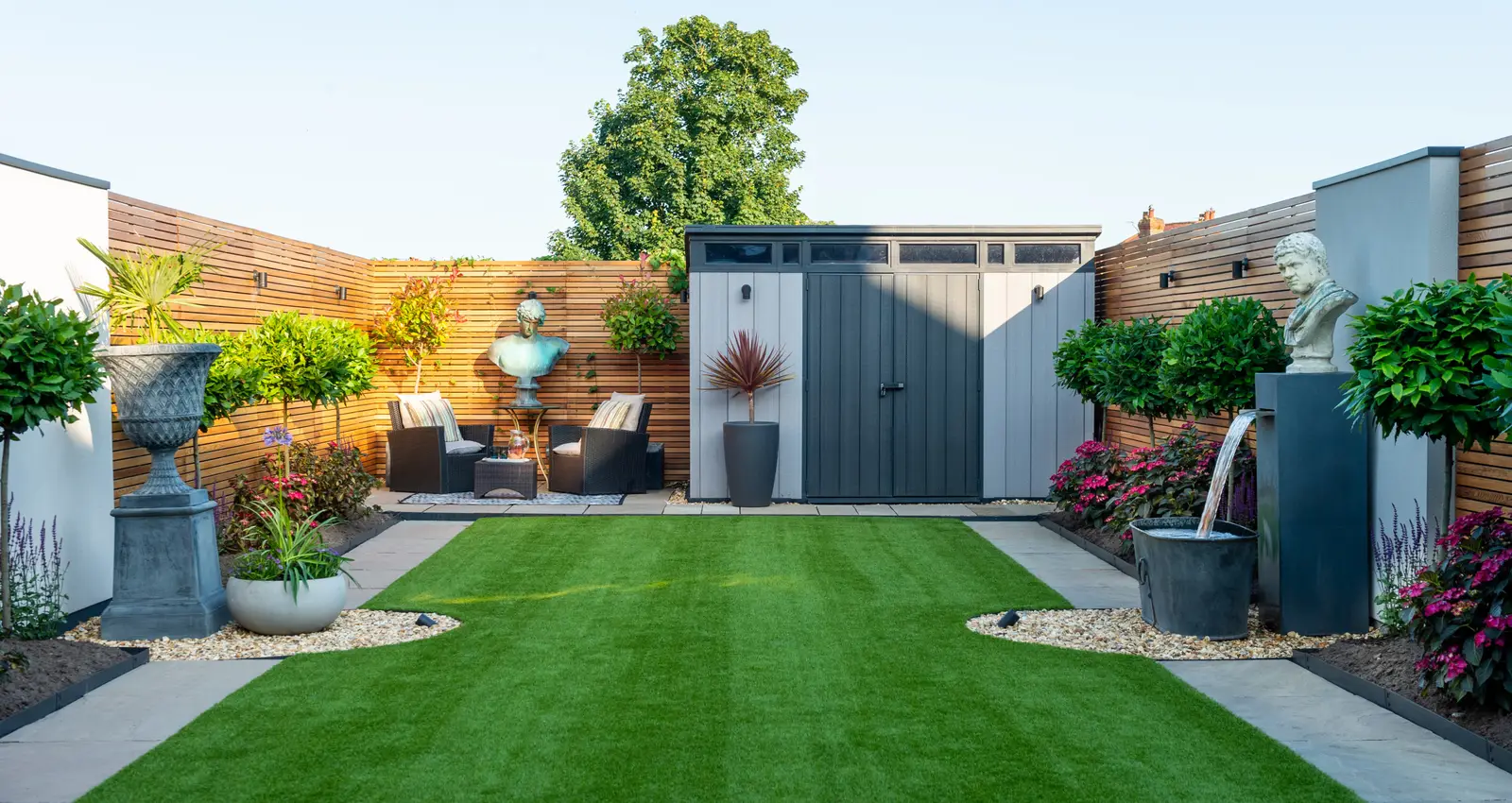
A common approach is to mix the two: real grass in the open, sunny part of the garden where people sit and play, and artificial grass in shaded strips and corners. If you live in a managed community, check with the community developer before changing your front garden surface, as some communities may have rules on front landscaping.
Front garden grass ideas and grass borders for lawn edges
A front lawn shapes how your villa looks from the street, so a simple, well-kept layout usually works better than a complicated one.
- Keep the shape simple. A clean rectangle or a gentle curve is easier to mow and water evenly than many small islands of grass.
- Match grass to sun. Front gardens often get full afternoon sun, which suits paspalum or bermuda. Use zoysia or artificial grass in the shaded strip beside the boundary wall.
- Frame the lawn. A planted bed of heat-tolerant shrubs along the edge gives the lawn a finished look.
A solid garden grass border is worth adding, especially with bermuda, which spreads by runners into beds and gravel. Stone, concrete or metal edging set slightly below lawn level stops the spread and lets the mower wheel run along it, so you need less hand trimming. For more layout ideas, see our guide to front yard and villa entrance ideas, or our backyard landscaping ideas for Dubai for the rest of the garden.
Lawn care in Dubai: doing it yourself or getting help
A real lawn in Dubai needs attention every week, and in summer a missed irrigation fault can brown a lawn within days. You can manage it yourself if you are home most of the year and comfortable adjusting an irrigation controller.
If you travel in summer or prefer not to handle mowing, feeding and irrigation checks, regular garden lawn maintenance takes that risk away. When comparing options, check that a contract lists visit frequency, mowing, edging, feeding, irrigation checks and seasonal schedule changes, plus how you will be updated after each visit.
NAM Landscaping offers garden maintenance in Dubai and annual maintenance contracts for villa gardens, with a photo report sent to your WhatsApp after every scheduled visit.