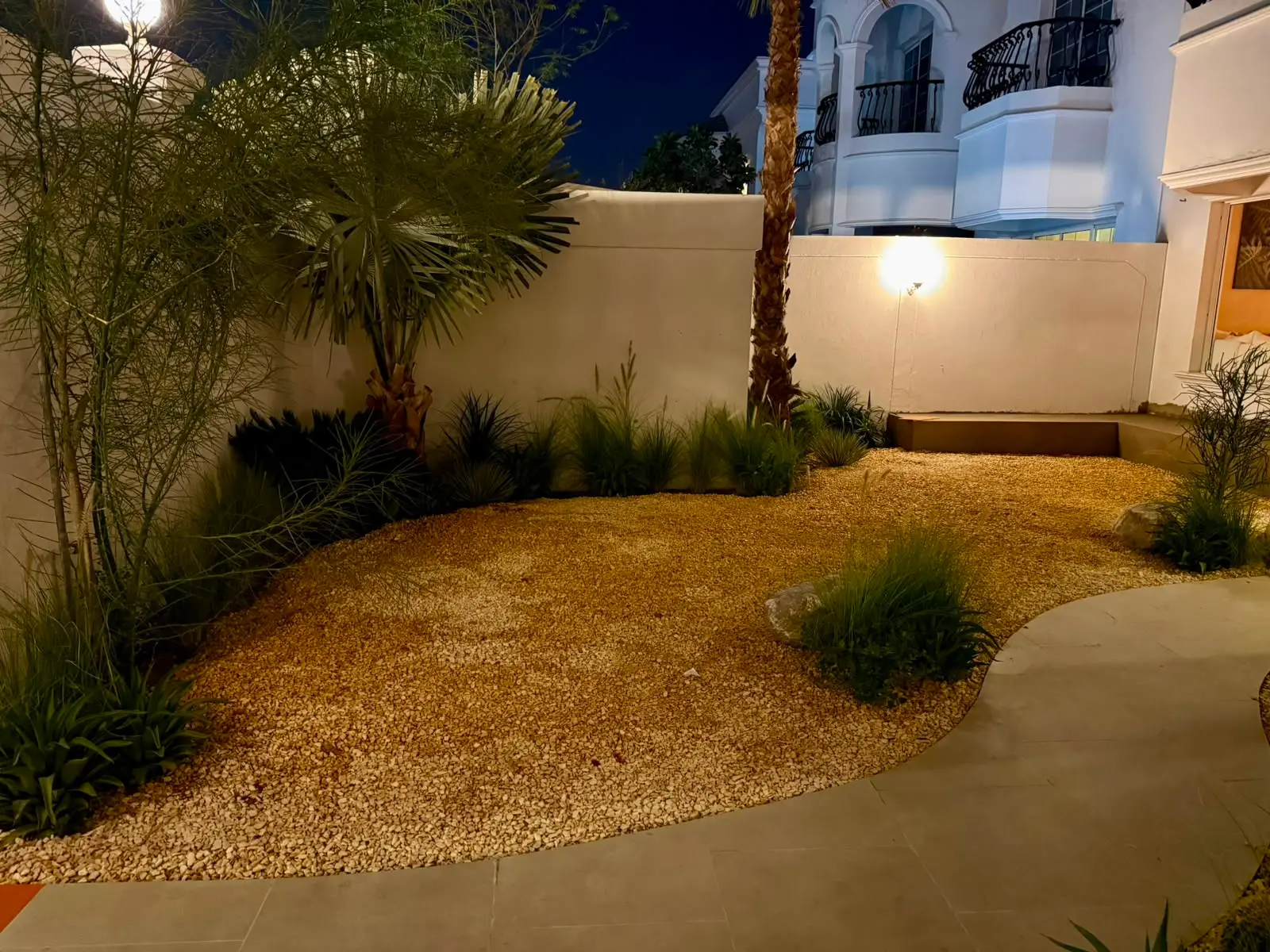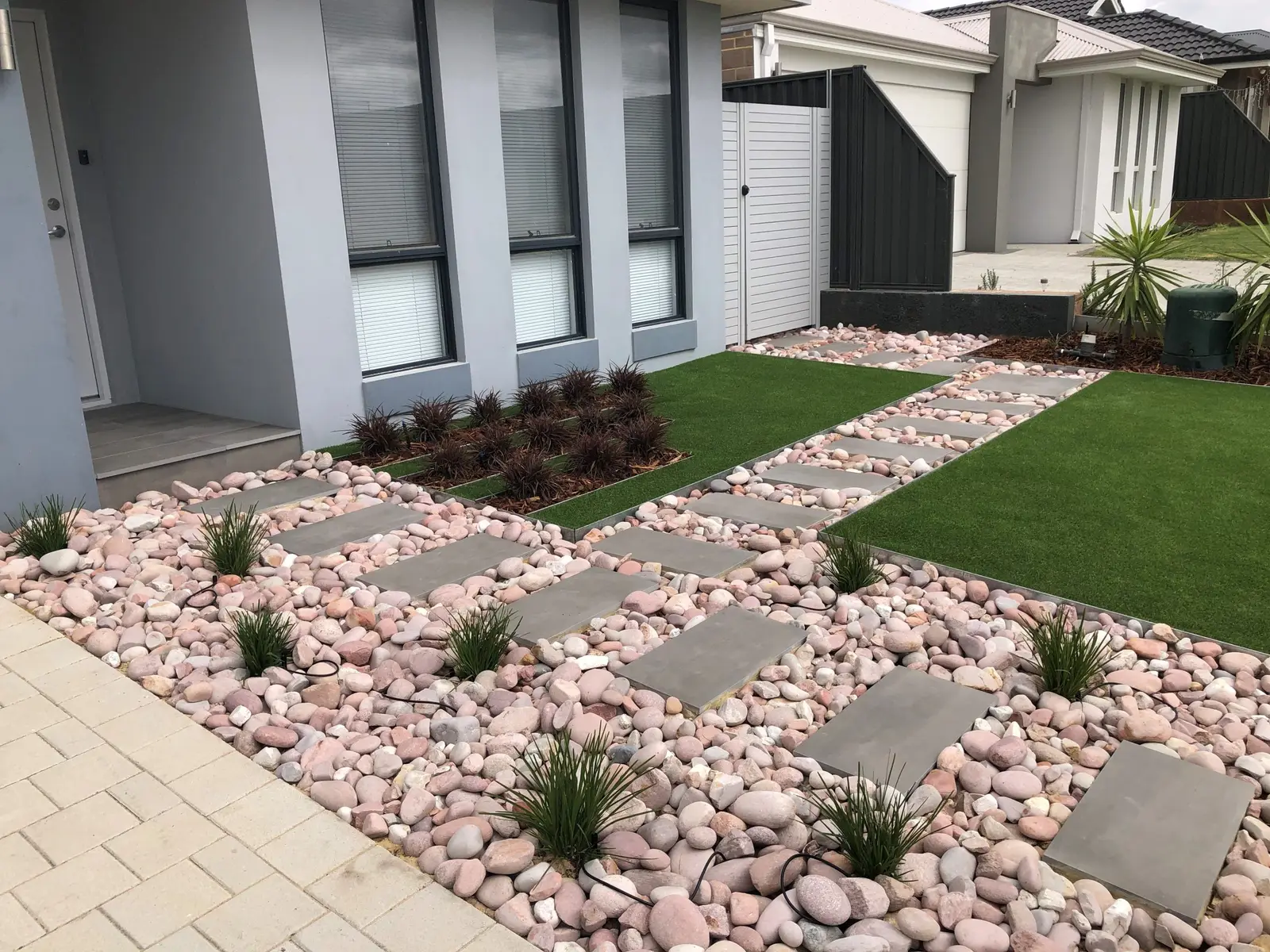
The best garden wall and fence ideas for a Dubai villa give you privacy without trapping heat or fighting the wind. For most gardens that means a mix: a solid or rendered wall where you need full privacy, and a slatted screen in aluminium or composite where you want airflow and a lighter look. Plants in front of both soften the result and add shade.
Below you will find the main options, how to choose between them, and the Dubai checks (heat, wind, dust and community approval) that decide whether a design lasts.
What should you check before choosing a wall or fence in Dubai?
Start with three questions: what the barrier is for, what your community allows, and where the wind and sun hit it. The answers narrow your options quickly.
Purpose: privacy, security, noise or decoration
A privacy screen for a seating area only has to block sightlines, so a slatted panel at the right height works. A boundary wall needs strength, a proper foundation and often approval, so masonry is the usual choice.
Community rules and permits
Many Dubai villas sit inside master communities where the developer controls what you can build on or near a boundary. Guidelines commonly cover height, colour, material and whether a fence can be seen from the street. Rules differ between communities, so ask your developer or owners' association for them in writing before you design anything.
Dubai Municipality sets out its building permit procedures online, and its permit FAQ says the setbacks shown on the planning map must be respected. The setback point refers to villa plots on the planning map and does not spell out rules for every garden wall. Whether your wall needs a permit, and what height is allowed, depends on your plot and community, so confirm both before you build.
Sun, wind and dust
Dubai summers are long and hot. On 6 July 2026, for example, Dubai's forecast high was 42°C. Surfaces in direct sun get hotter than the air, so a dark metal panel or dark cladding can be uncomfortable to touch in the afternoon. Choose lighter colours and matte finishes where people or children will lean on the surface.
Wind and dust matter too. A solid wall looks like the most protective option, but it forces air over the top and creates turbulence behind it. University of Florida extension guidance on farm windbreaks notes that lower porosity produces stronger turbulence on the sheltered side. That advice is about tree windbreaks, but the same principle applies by analogy to garden screens. If you want shelter rather than total blocking, a slatted or part-open screen is often a better choice.
Which garden wall designs work best for Dubai villas?
Masonry walls suit boundaries and any place where you need strength and full privacy. Choose the finish by how much upkeep you accept and how visible the wall is from the street.
| Wall type | Best for | Main limitation |
|---|---|---|
| Rendered and painted block | Boundaries, budget-conscious projects | Needs repainting over time; dust shows on dark colours |
| Natural stone cladding | Feature walls, entrances, a warm texture | Higher cost; porous stone can stain |
| Porcelain cladding | Contemporary garden wall ideas, easy cleaning | Needs careful fixing and good joints |
| Exposed brick or block | Informal, textured looks | Less common in villa communities; may not be allowed |
Rendered walls with planters
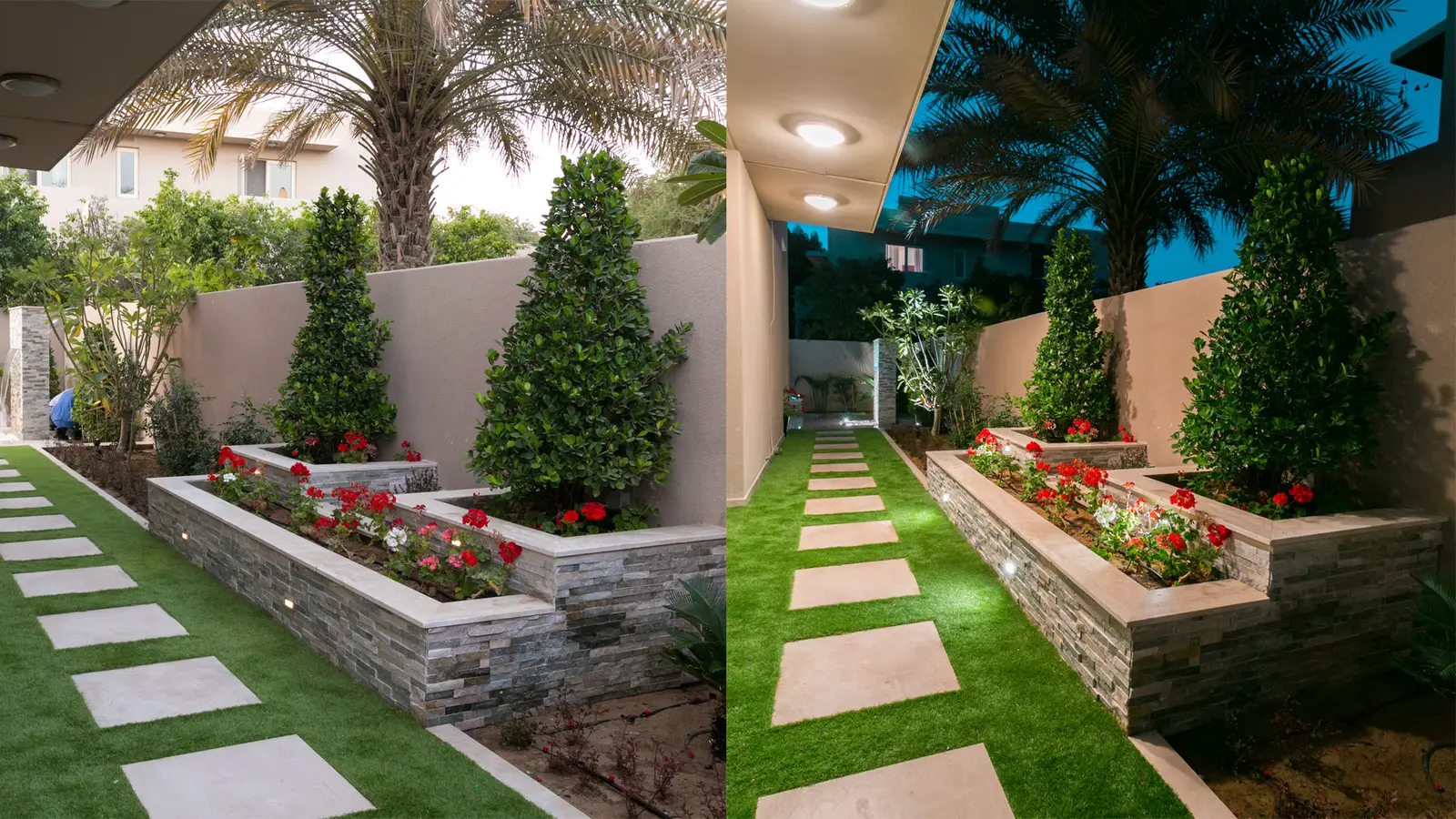
A rendered wall is the simplest base. Painted in a light colour, it keeps the garden brighter. Built-in planter boxes or a raised bed along its foot add depth, and they give climbers a place to root without digging up the boundary.
Stone and porcelain cladding
Cladding turns a plain wall into a feature. Stone gives a natural, layered look, while porcelain gives a clean, modern surface that wipes down easily after a dust storm. If your budget covers only part of the wall, clad the section people see most, such as behind a seating area or beside the entrance.
Contemporary and decorative looks
For contemporary garden wall ideas, keep the lines simple: one colour, clean joints and a single feature such as a horizontal slat panel, a clad section or a glass-style panel where you want to keep a view. Low decorative fences, such as a short metal or slat run, define a bed or path edge without closing the garden in.
Wall decor and feature walls
A plain wall can carry a feature: wall art made for outdoor use, a wall-mounted water feature, or built-in lighting that washes the surface at night. Our garden lighting ideas show how to light a feature wall without glare. Pick one or two accents rather than covering every surface.
Courtyard walls
In a small courtyard, a wall is often the main design feature. Use a light colour to keep the space open, and add one textured panel or a wall-mounted water feature rather than decorating every surface. Our small garden ideas guide shows how to keep walls from overwhelming a compact space.
What fence ideas give privacy without blocking airflow?
Slatted screens are the most useful answer. Horizontal or vertical slats with narrow gaps block direct views while letting air through, which helps with both heat and wind.
Aluminium slat screens
Powder-coated aluminium does not rot and does not need painting, which suits Dubai's sun and dust. It comes in many colours, including woodgrain finishes. Black and other dark colours look sharp and are popular for fences, but they absorb more heat in direct sun, so test a sample in the afternoon before you order a full run. Light greys, sand and cream tones stay cooler and suit a small garden because they make the space feel larger.
WPC and composite screens
WPC (wood-plastic composite) is made from wood fibres and plastic. It looks like timber but resists rot and does not need regular oiling. Plastics can expand and contract with temperature, so ask the supplier about expansion gaps and fixing methods for hot climates.
Timber
Natural timber looks warm and works well for a decorative garden fence, but sun and irrigation spray age it quickly. It needs regular sealing, so it suits small accent screens better than long boundaries.
Bamboo and lattice
Bamboo screens and lattice panels are usually cheaper than other screening options and add privacy fast. They also fade and weaken in strong sun, so treat them as short-term options, not permanent boundaries. Lattice works well behind a climber, which will eventually do the screening.
DIY or contractor?
A simple DIY privacy screen for a patio, such as a freestanding lattice or slat panel in a planter, is a reasonable weekend job and a cheap way to test a layout. Anything on a boundary, anything tall enough to catch wind, and anything that needs a foundation is better built by a contractor, because a failed fence can damage property or hurt someone.
Metal and wrought-style fences
Decorative metal fencing suits front gardens and entrances where you want a defined edge without a solid wall. It gives security and a classic look, but little privacy on its own, so pair it with a hedge or climbers if you want to block the view. For the street side of the plot, see our guide to villa entrance and front yard ideas.
How do green walls and climbers add privacy?
Plants soften a hard boundary and can add shade and some cooling. A climber on a trellis, a row of tall shrubs or a planted wall all do the same job: they fill the gaps in a fence with living cover.
Bougainvillea is a common climber for Dubai gardens. NC State's plant guidance describes it as a plant suited to hot climates that flowers best in full sun and resists drought once established. It also has curved thorns and needs a support, so plant it where people will not brush past it, and prune right after flowering to control its shape.
Plan irrigation before you plant. A wall in direct sun dries soil quickly, so a drip line along the base is more reliable than hand watering. For heat-tolerant plant choices, see our guide to the best outdoor plants for Dubai.
Planting along a fence line
A simple border along a fence needs only three layers: climbers or tall shrubs against the fence, mid-height shrubs in front, and a low edge of groundcover or gravel. Leave a gap behind larger plants so you can reach the fence for cleaning and repairs. Run one drip line along the whole border so every layer is watered on the same schedule.
What retaining wall ideas suit a sloping or raised garden?
A retaining wall holds soil back where levels change. Raised beds, a sunken seating area or a step between a driveway and a lawn all need one.
Materials
Concrete block is common and cost-effective, and it can be rendered or clad to match the rest of the garden. Poured concrete suits taller or curved walls, while brick gives a classic look but is less common in Dubai villa communities. Natural stone gives a more traditional look. For a driveway retaining wall, choose a finish that tolerates vehicle knocks and plan the drainage along its base. Whatever the material, a retaining wall needs drainage behind it, because trapped water adds pressure and is a common cause of failure.
When to bring in an engineer
A low wall that only edges a raised bed is simple. A taller wall that holds back a driveway, a pool deck or a boundary carries real load, so an engineer should design it and it needs a proper foundation. Ask your contractor at what height they require an engineer's design, and confirm any permit requirement with Dubai Municipality or your developer.
How do you choose between a wall and a fence?
Choose a wall when you need strength, security or complete privacy. Choose a fence or screen when you want airflow, a lighter look or, often, a lower cost per metre. Most good gardens use both.
- Boundary with neighbours or a road: masonry wall, usually with developer approval.
- Seating or dining area: a slatted screen or a short wall with a planter on top.
- Around a pool: an open fence or glass-style panel that keeps views clear. Pool barriers have their own safety rules, so check them separately before you design.
- Deck or balcony edge: a lightweight slat screen. See our patio and paving ideas for how screens fit with the paving.
- Along a side passage: a narrow planter wall or trellis that adds green without taking much width.
Height is the usual trade-off. Taller screens give more privacy, but they cast more shade, catch more wind and are more likely to need approval. Aim for the lowest height that solves your privacy problem.
What do garden walls and fences cost in Dubai?
Cost depends on height, length, foundation, material and finish, so any figure without a site visit is a guess. As an indicative starting point, NAM Landscaping's hardscaping and paving work starts from AED 75 per m² supplied and laid, with the price confirmed in writing after a free site visit. The price is confirmed in writing after a free site visit.
To keep costs down, build the main boundary in simple rendered block and spend on one feature section, such as a clad wall behind a seating area. A planted screen on a basic fence is another low-cost route, though it takes time to fill in.
How do you keep a wall or fence looking good in Dubai?
Dust is the main cleaning job. Wipe or rinse slat screens and cladding regularly, and check fixings after strong wind. Repaint rendered walls when the colour fades or cracks appear, and keep irrigation spray off timber and untreated metal.
Near the coast, humidity and salt air can attack poorly coated metal, so ask for the coating specification and inspect fixings each year. Plants need steady watering, and pruning climbers stops them adding too much weight to a light fence.
If you want one team to design, build and maintain the garden, NAM Landscaping can handle boundary walls and outdoor upgrades alongside garden landscaping under a single contract.