The best garden lighting ideas use several small, warm lights at different heights instead of one bright floodlight. Light the paths and steps first for safety, then add a few accent lights on trees, walls and seating areas. In Dubai, choose LED fixtures with a dust-tight rating (IP65 or higher), keep the light warm and shielded, and put the system on a timer.
This guide explains each type of light, where it works, and how to choose fixtures that cope with Dubai's heat, dust and humidity. It covers patios, decks, driveways, small gardens and pools.
How do you plan outdoor lighting in layers?
Layered lighting means using three kinds of light together: safety light, accent light and mood light. Each layer does a different job, and the garden looks balanced when all three work together.
- Safety (task) light: low, even light on paths, steps, driveways and gates so people can walk safely.
- Accent light: focused beams that highlight a palm, a sculpted wall or a water feature.
- Mood (ambient) light: soft light around seating areas, such as lanterns, string lights or a glow under a bench.
Plan from the house outward. Stand where you normally sit in the evening and note what you see: the view from your majlis, terrace or living room window matters more than the view from the street. Light a few things you want to see, and leave the rest dark. Fewer, better-placed lights nearly always look better than many bright ones, because dark areas give the lit areas depth.
What are the main types of garden lights?
Each fixture type has a clear purpose. This table shows where each one fits best.
| Fixture type | Best for | Watch out for |
|---|---|---|
| Path or bollard lights | Walkways, borders, driveway edges | Glare if the bulb is visible from the side |
| Spike (spot) lights | Trees, palms, shrubs, statues | Beams aimed up with no shield; they spill into the sky |
| Wall washers and wall lights | Boundary walls, feature walls, facades | Hot spots on rough surfaces |
| Step and riser lights | Stairs, raised decks, level changes | Fixtures that fill with dust or water |
| In-ground (well) lights | Uplighting from lawn or paving | Need drainage and a high IP rating |
| Strip and rope LEDs | Under benches, pergola beams, retaining walls | Low-quality strips can fade or peel in strong sun; choose outdoor-rated, UV-resistant types |
| String and festoon lights | Patios, courtyards, pergolas | Exposed cables; use outdoor-rated types only |
Which lighting ideas work for different parts of the garden?
Paths and driveways
Path lights should show where to step without lighting the whole garden. Place low fixtures on alternating sides of a path, spaced so the pools of light just overlap. A path light that is too tall or too bright creates glare and a harsh stripe of light across the lawn.
For driveway lighting ideas, mark the edges and the gate area instead of flooding the whole surface. Low bollards or small in-ground markers guide drivers and are less likely to shine into neighbouring windows. Solar driveway lights can work as decorative edge markers because they need no cable, but dust on the panel and a short run time mean they should not be the only light on a drive.
Front of house and facade
For exterior home lighting ideas, start at the entrance. Warm downlights above the front door and gate show visitors where to go, and a washed gate wall or boundary wall gives the front yard a clear backdrop at night.
For modern outdoor lighting at the front of the house, keep the look simple: a few warm uplights grazing the facade, small step lights and one or two lit plants. Avoid bright floodlights aimed at the street. If you are also redesigning the approach to your house, see our front yard and villa entrance ideas.
Trees and palms
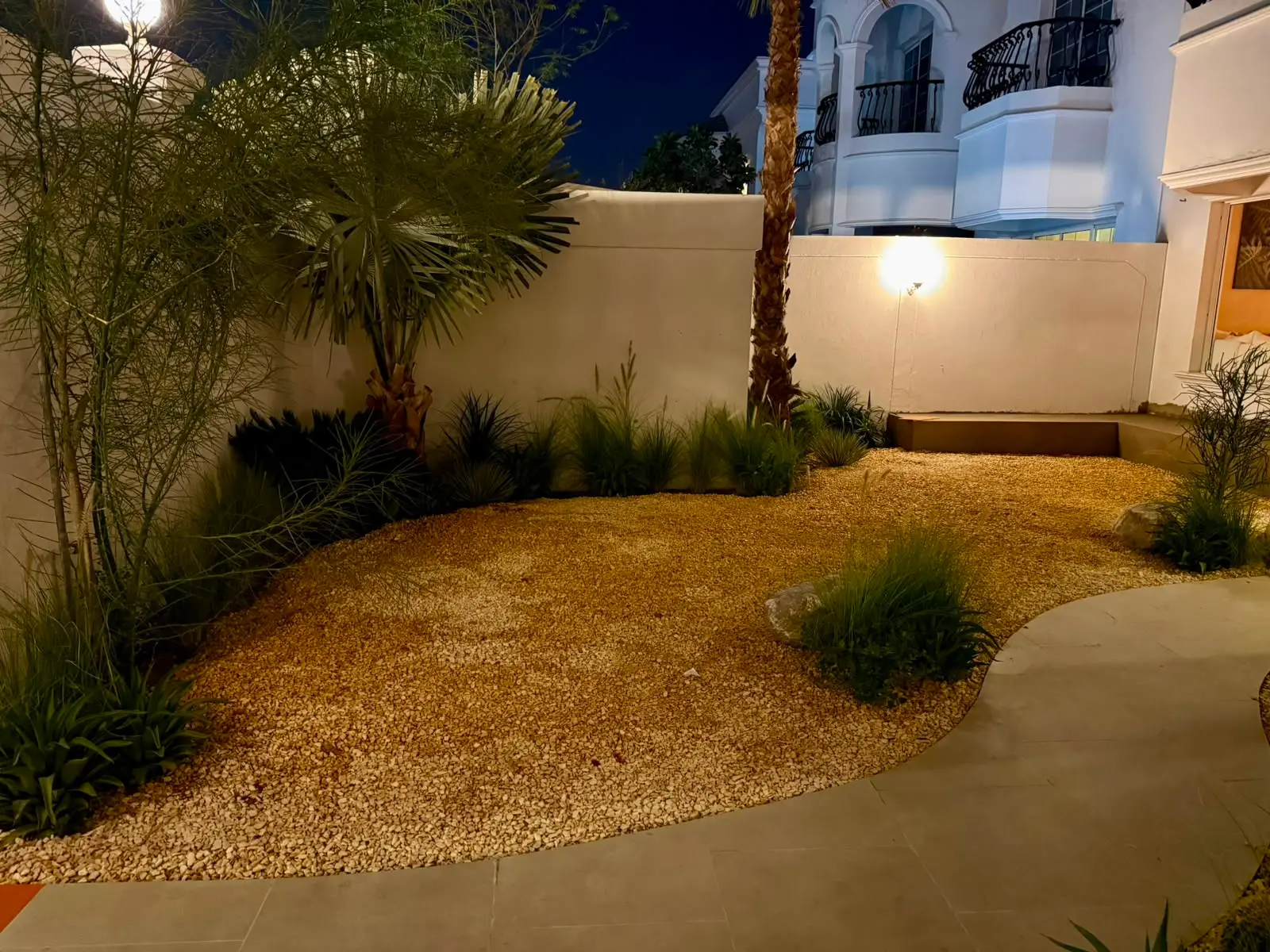
Uplighting a palm or a mature tree is one of the most effective landscape lighting ideas. Place a spot light at the base and aim it up the trunk and into the crown. Two lights from different sides give a fuller shape than one.
Moonlighting is the opposite: a fixture mounted high in a tree and aimed down creates soft shadows on the lawn below, like moonlight through leaves. It works best in larger gardens with mature trees.
For lawn lighting, avoid lighting the whole grass area. A few low fixtures along the lawn edge, or a single uplight on a tree at the far end, give depth without a flat wash of light.
Walls, fences and retaining walls
Walls give lighting a surface to reflect from. Wall washing spreads soft light across a feature wall, while grazing places the fixture close to the wall so light skims the surface and shows its texture, which suits stone cladding or rough render.
For retaining wall lighting, small LED fixtures built into the wall cap or the underside of a coping stone give a clean line of light with no visible fixture. For a garden fence, low downlights or a warm strip on the inside of the posts add a glow without lighting the boundary line. If you are planning a new wall or fence, our guide to garden wall and fence ideas in Dubai covers materials and styles.
Patios, courtyards and decks
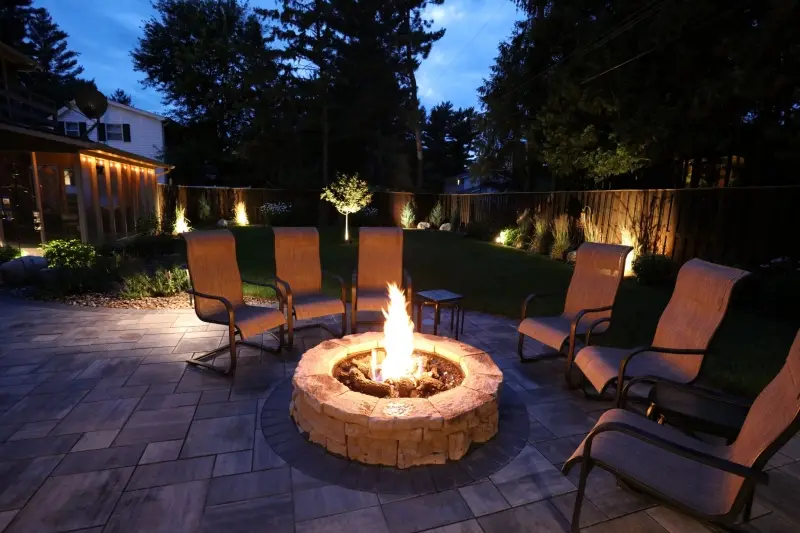
Patio lighting should feel soft and sit lower than eye level. Wall lights beside doors, lanterns on the table, string lights above the seating and a few low lights in planters give enough light to eat and talk without glare.
For deck lighting ideas, recessed lights in the deck boards, small lights on the posts and LED strips under the handrail or under stair edges all work. Under-deck and under-bench lighting adds a floating effect. Choose LED fixtures for timber decks, because a light in direct contact with wood should stay cool, and an LED runs much cooler than a halogen.
Paving can carry light too. Small lights set into the joint or edge of a patio mark the edge of the space, and they pair well with the options in our patio and paving ideas for Dubai.
Pergolas and shaded areas
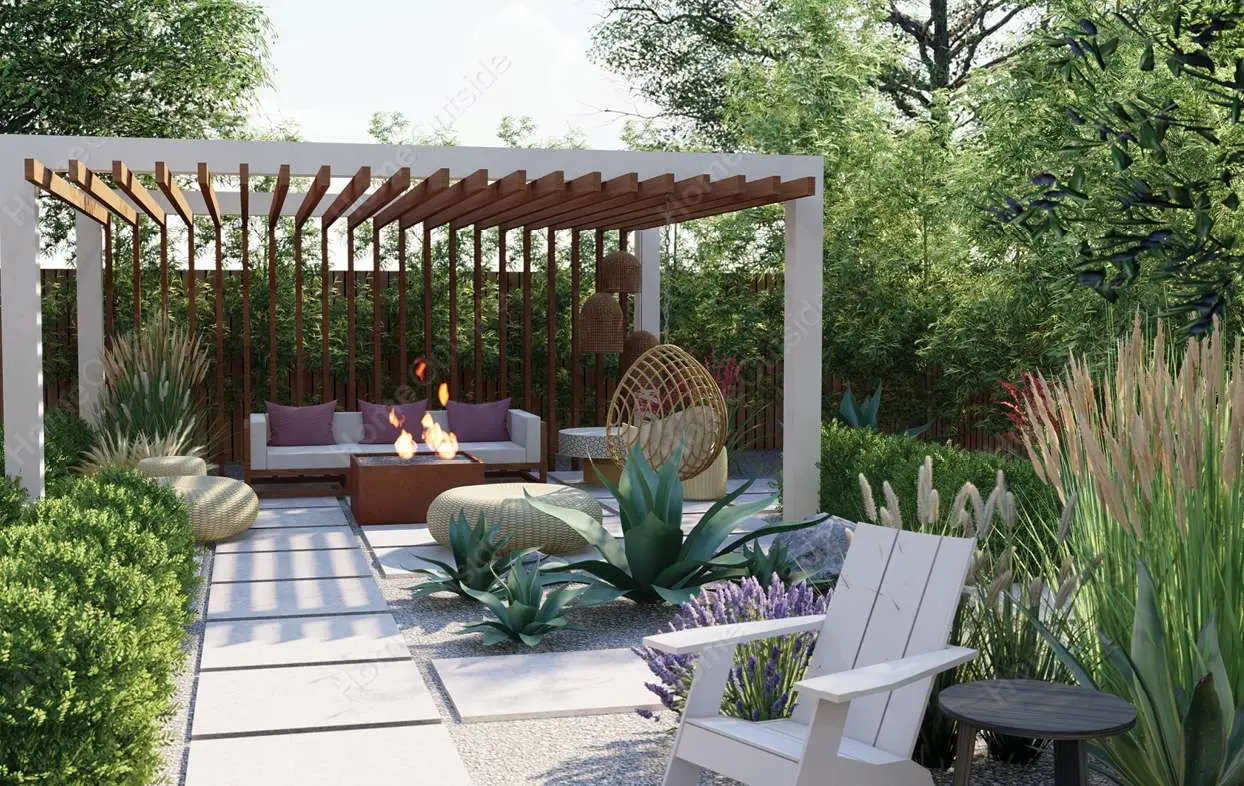
A pergola gives you a ready-made frame for lights. Strip lights along the inside of the beams, small downlights in the rafters or lanterns hanging from the crossbeams all create a cosy room-like feel. Hanging pendants and lanterns work well over a dining table, as long as they are outdoor-rated and fixed securely against wind. Keep the wiring neat and hidden inside the structure.
The same ideas suit a shed, a majlis or a garden pavilion. One shielded wall light by the door, switched by a dusk sensor or timer, is usually enough for outdoor shed lighting or pavilion lighting, and it avoids leaving a bright bulb on all night.
Plan the cabling before the pergola is built or finished, because adding it later can mean visible cables. Our pergola and shade ideas for Dubai and our pergola and shade structures service explain the structure options.
Pools and water features
Pool lighting has two parts: the lights in the water and the lights around it. Underwater lights must be made for that use, and they should be fitted by a qualified person. Around the pool, keep light low and soft so it does not reflect as glare on the surface. Lighting a nearby tree or wall gives a reflection on the water that looks good from the house.
Aim any lights near the pool away from bedroom windows. More ideas for the pool area are in our pool landscaping ideas.
Small gardens and courtyards
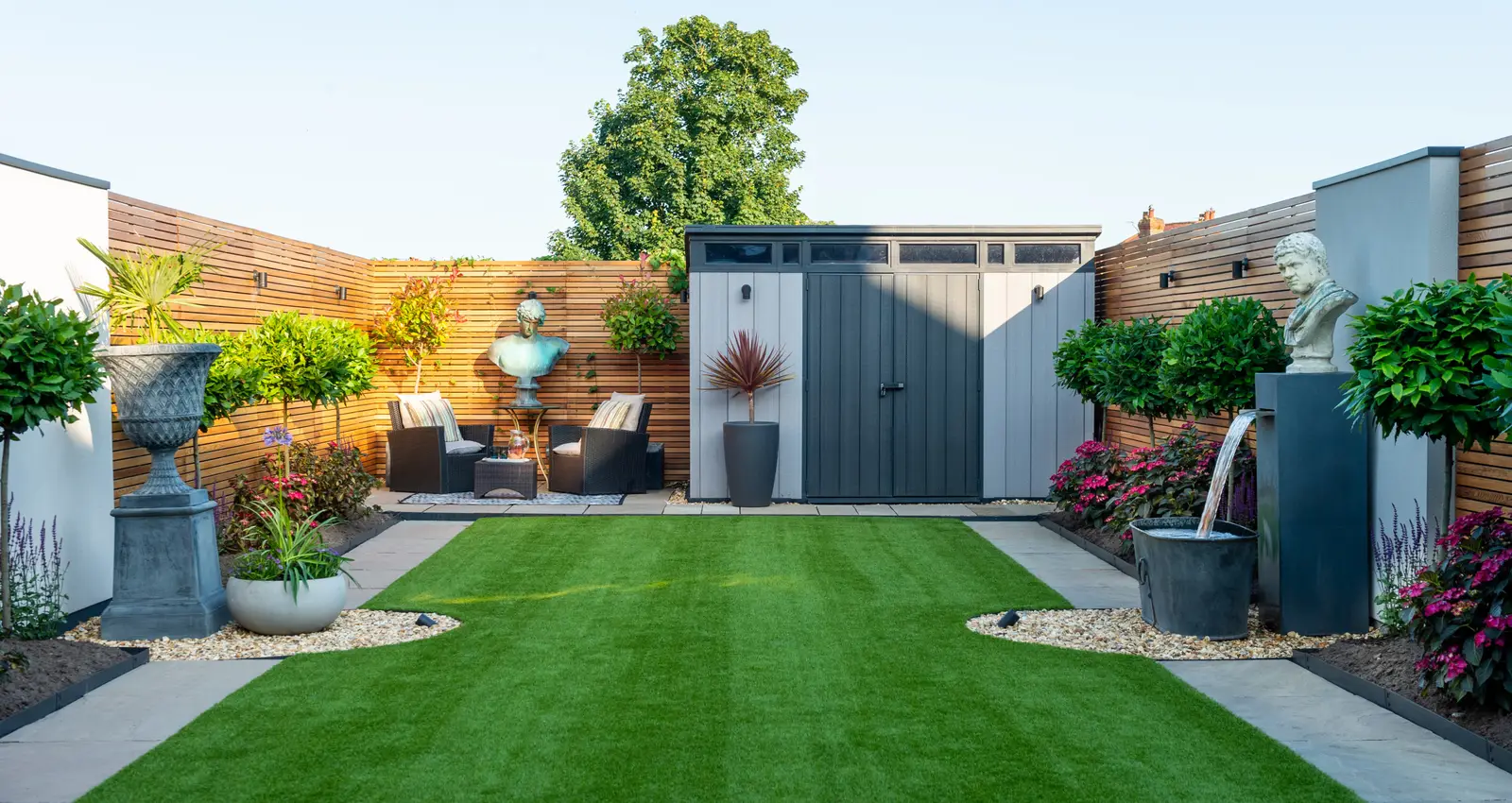
For small garden lighting ideas, choose one focal point and a few supporting lights. A lit wall, a lit tree or a lit water feature is enough. Add step lights if there are level changes, and one warm light near the seating.
In a small space, hide the fixtures and show the light. Fixtures hidden in planters, under benches or behind a plant make the garden feel larger than it is.
What colour of light is best for a garden?
Warm white light, around 2700K, suits most gardens. The K stands for kelvin, a measure of colour: lower numbers look warm and yellow like candlelight, and higher numbers look cool and blue-white like daylight.
Warm light flatters green leaves, timber and stone, and it feels relaxing. DarkSky, an organisation that works on responsible outdoor lighting, lists "warm-colored" as one of its five principles of responsible outdoor lighting, because blue-rich light causes more glare and more light pollution.
Use the same warm tone across the whole garden. Mixing 2700K and 4000K fixtures looks patchy at night. Coloured lights (RGB) can be fun for a party or a pool, but they date quickly, so use them as a feature and not as the main lighting.
What IP rating do garden lights need in Dubai?
For open garden areas in Dubai, choose lights rated IP65 at a minimum, and IP67 or IP68 for lights set into the ground or in water. An IP rating (Ingress Protection) tells you how well a fixture is sealed against dust and water. The standard behind it is IEC 60529.
The rating has two digits. The first digit covers solids and dust, and the second covers water. As explained in this IP rating reference, a first digit of 6 means fully dust-tight.
- IP65: dust-tight and protected against water jets from any direction. Good for wall lights, path lights and spots in open areas. It is not meant for immersion.
- IP67: dust-tight and protected against temporary immersion. A good choice for in-ground lights that can sit in water after rain or irrigation.
- IP68: dust-tight and made for continuous immersion, to a depth and time the maker states. Check the maker's conditions, because they vary. Use it for underwater or permanently wet locations.
Dust matters in Dubai because fine sand gets into poorly sealed fixtures and can shorten their life. Water matters too, because irrigation, lawn sprinklers and pool splash all reach fixtures. A higher number is not automatically better for every job. The water tests for jets and for immersion are separate, so an IP67 or IP68 fixture has not necessarily been tested against jets. Read the maker's data sheet if the fixture will be hosed down or hit by sprinklers.
Heat is the other test. A July 2026 Khaleej Times report on forecasts from the UAE's National Centre of Meteorology listed Dubai highs of up to 42°C. Choose fixtures with metal or UV-stable housings and a stated operating temperature that covers this, and avoid thin plastic fittings in full sun.
Should you choose low-voltage, mains or solar lights?
Low-voltage lights are the safest and most flexible choice for most garden schemes. A transformer reduces mains power to a lower voltage (commonly 12 volts) before it reaches the fixtures. That makes the cables in the garden safer, and it lets you add or move lights later.
| Type | Best for | Main limitation |
|---|---|---|
| Low-voltage | Paths, trees, walls, steps, most garden schemes | Needs a transformer and careful cable planning |
| Mains-voltage | Wall lights, floodlights, gate and driveway posts | Needs a qualified electrician and protected, buried cable |
| Solar | Decoration, small accents, areas with no power | Dim light, shorter run time, dust on the panel |
Solar outdoor lighting ideas are popular because there is no wiring and Dubai has a lot of sun. The weakness is brightness and run time: small panels and batteries often give weak light late at night, and dust on the panel reduces charging. Use solar lights as decoration, and use wired lights for paths, steps and any area where safety matters.
If you like to build things yourself, DIY garden lighting ideas that work well include solar lanterns, battery-powered candles, plug-in string lights rated for outdoor use, and plug-and-play low-voltage kits. Keep mains wiring, outdoor sockets and pool lighting for a qualified electrician.
How do you keep garden lighting cheap to run?
LED lights use less electricity than older halogen lights, so a full garden scheme can run on a small load. For cheap outdoor lighting ideas, the biggest saving comes from using fewer lights, dimmer light and shorter running hours. A clever layout beats a large number of cheap fixtures.
Cheap fixtures can cost more over time. Poorly sealed lights fill with dust and water, and thin housings can crack in the sun. If your budget is limited, spend first on the lights that are hardest to reach later, such as in-ground and wall lights.
How do smart timers and controls help?
A timer or smart controller switches your lights on and off automatically, so they run only when you need them. Common options are:
- Dusk-to-dawn sensor: turns lights on when it gets dark.
- Time schedule: for example, all lights on until 11 pm, and path lights only after that.
- Zones and scenes: separate groups, such as "dinner" or "party", controlled from your phone.
- Motion sensors: useful on side passages and gates.
Controls also support the "controlled" principle from DarkSky's outdoor lighting principles: light should be available when needed and turned down or off when it is not. For a family garden, a simple timer plus a dimmer is often all you need.
How do you avoid glare and light spill?
Place each fixture so you see the light, not the bulb. Glare is bright light that hurts your eyes. Light spill is light that falls where you did not want it, such as a neighbour's bedroom window or the street. Both usually come from poor aiming.
These steps reduce both:
- Choose fixtures that hide the bulb from the side, such as shielded or hooded fittings.
- Aim spot lights at the object, not outward, and angle them downward where you can.
- Use the lowest brightness that does the job.
- Test after dark before fixing anything permanently, and walk to your boundary to check what a neighbour would see.
- Switch off decorative lights when nobody is outside.
DarkSky's principles also say lights should be "targeted", meaning aimed only where they are needed, and "low level", meaning no brighter than the task requires. In a villa community, these points also help you stay on good terms with neighbours. Check your community developer's rules before changing exterior or facade lighting, because some communities have their own guidelines.
What does a professional lighting design include?
A designer plans where each light goes, what beam it needs, how it is powered and how it is controlled. Good design also coordinates lighting with planting, paving, irrigation and furniture, so that cables are buried in the right place and fixtures are not dug up later.
NAM Landscaping offers landscape lighting in Dubai alongside garden design and build, with a free site visit and a written, itemised quote. Because the same team handles garden and pool work, lighting can be planned together with the rest of the project: see also garden landscaping and design.