The pergola ideas that work best in Dubai are the ones that give real overhead shade, not just a pretty frame. For most villas that means an aluminium pergola with a solid, louvred or fabric roof, placed where you actually sit, and planned for summer heat, dust and coastal humidity from the start.
This guide compares the main materials and roof types, explains when an attached or freestanding design makes sense, and covers lighting, rooftop pergolas, sizing and the approvals you will usually need in a villa community.
Why shade matters more than style in Dubai
Dubai summers are long and very hot. On 2 August 2026, for example, the National Centre of Meteorology forecast a high of 46°C in Dubai with an overnight low of 33°C. A garden or terrace without shade is hard to use for much of the day between late spring and autumn.
Shade also protects you from ultraviolet (UV) light, the part of sunlight that burns skin. Cancer Institute NSW says that quality shade can cut UV exposure by up to 75%, and it warns that UV still reaches you from the sides and from reflective surfaces such as water and sand. Its simple test is useful: the less open sky you can see from your seat, the better the shade.
This affects the design directly. At midday in summer the sun is high overhead, so an open slatted roof lets a lot of light straight through. In the late afternoon the sun is low in the west, so a roof alone will not shade you. A comfortable pergola usually needs a closed or adjustable roof plus side protection on the sunny side.
Pergola materials compared for Dubai heat
Five options cover most Dubai projects. The table compares how each handles heat, how long it lasts and how much care it needs.
| Option | Heat and comfort | Durability in Dubai | Upkeep | Best for |
|---|---|---|---|---|
| Aluminium (powder-coated) | Frame can get hot in direct sun; light colours stay cooler. Shade depends on the roof you add. | Does not rot, warp or attract termites. Coating quality matters near the coast. | Low: rinse off dust, check fixings. | Most villas, modern designs, attached pergolas |
| Timber | Stays cooler to the touch than metal. Open slats give partial shade only. | Sun and moisture weather unprotected wood: it greys, roughens and checks. | High: regular sanding and refinishing. | Warm, traditional look; covered spots out of full sun |
| WPC (wood-plastic composite) | Dark colours absorb more heat. Lighter tones are more comfortable. | Resists rot; expands and shrinks with temperature, so expansion gaps matter. | Low: washing, no staining. | A timber look with less maintenance |
| Louvred (bioclimatic) roof | Adjustable blades give full shade at midday and airflow when opened. | Aluminium blades and frame; motors and seals need care. | Medium: clean blades and gutters, service the motor. | Year-round dining and lounging spaces |
| Shade sails | Good overhead shade over large areas; fabric usually stays cooler than bare metal. | Fabric can wear faster than metal in strong UV; needs strong anchor points. | Medium: re-tension, clean, replace fabric over time. | Large areas, play spaces, lower budgets |
Aluminium pergola designs
Aluminium is a very common choice for Dubai villas because it handles the climate with very little care. It does not rot, swell or get eaten by insects, and a powder-coated finish comes in wood-effect and plain colours.
If you live on the Palm or near the coast, ask whether the powder coating and its pre-treatment are specified for coastal or salty air. A cheaper coating can blister or flake over time, which spoils the look before the frame itself fails.
Timber pergolas
Timber gives the warmest, most natural look, and wood stays more comfortable to touch than metal in the sun. The trade-off is maintenance. The US Forest Products Laboratory notes that unfinished wood exposed to the weather changes colour, roughens from sunlight and surface checking, and slowly erodes.
In Dubai's strong sun, plan to refinish timber regularly. Some villa communities also limit the materials you can use for exterior structures, so check before you choose wood.
WPC pergolas
WPC is a composite made from wood fibre and plastic. It gives a timber look without staining or sealing. Choose a light or mid tone for anything in full sun, because dark boards absorb more heat. Make sure the installer follows the manufacturer's expansion-gap guidance.
Louvred (bioclimatic) pergolas
A louvred pergola has a roof of aluminium blades that rotate. Closed, they form a solid roof. Open, they let hot air escape and light in. One manufacturer's specification describes blades that rotate up to 150° with rainwater drained through gutters and the columns. This is why the design is often called "bioclimatic": you adjust it to the weather.
Louvred roofs usually cost more than fixed roofs because of the moving parts and motor. They make most sense for a space you use every day, such as an outdoor dining area.
Shade sails
Shade sails are tensioned fabric panels fixed to posts or walls. They cover big areas for less money than a framed roof and work well over play areas and around pools. When comparing fabrics, ask for the UV block figure as well as the shade percentage, since suppliers often quote them separately.
Sails need strong anchor points and regular re-tensioning, because gusty winds put a lot of load on fabric.
Attached or freestanding: which pergola design is right for your home?
The right choice depends on where you want shade and what your walls can carry.
Attached pergolas and wall-mounted designs
An attached pergola is fixed to the house wall on one side and stands on posts on the other. It is the simplest way to create a covered patio outside a living room or kitchen door, and it can shade glazing that faces the sun, which helps keep heat out of the room behind it. For a house pergola design on a villa facade, a ledger beam fixed to the wall carries one side of the roof, and the beam line usually looks best when it follows the line of the windows or the first-floor slab.
Two points need checking. First, the wall must be able to take the fixings, so an engineer or experienced installer should confirm this. Second, the roof must fall away from the house so rainwater and wash-down water drain outward, not against your walls.
Freestanding pergolas and gazebos
A freestanding pergola has its own posts on every corner. It can sit anywhere: over a pool lounge, at the end of the garden, or above an outdoor kitchen. A gazebo is a similar freestanding shelter, usually with a fully covered roof, and many modern gazebo designs in aluminium look like a freestanding pergola with a solid top.
A gazebo can also sit beside the house, with one side close to a door or terrace so it feels like part of the home. A backyard metal gazebo is easy to decorate: add curtains or screens for privacy, outdoor rugs, cushioned seating and soft lighting. Choose a powder-coated finish and fix the legs firmly, because gusty days put load on any roof.
3-post and 3-sided ideas
A 3-post design stands on three posts, with the fourth corner supported by a wall or a corner of the house, which suits a corner terrace. A 3-sided design adds fixed screens or blinds on two or three sides, which works well for privacy from neighbours.
Pergola designs with a roof: your main roof options
The roof decides how much shade you actually get. These are the main options for a backyard covered patio or alfresco area.
- Open slats: the classic pergola look. They give dappled shade but little cover when the sun is high, so they suit decoration more than comfort in summer.
- Solid insulated panels: full shade and rain cover. They allow ceiling fans and lights to be fitted, but the space underneath can feel darker.
- Louvred blades: adjustable shade and ventilation, as described above.
- Polycarbonate sheets: let light through and keep rain off. Clear sheets also let a lot of heat through, so tinted or opal sheets are usually more comfortable.
- Awnings, canopies and retractable covers: a lighter, lower-cost roof that can be pulled back in the cooler months. A wall-mounted awning over a door or window is a simple backyard canopy idea, and a retractable fabric roof on a pergola frame lets you choose between shade and open sky.
- Climbing plants: soft, living shade on an open frame. They take time to fill out and drop leaves and flowers, so keep them away from pools and dining tables.
Pergolas also fit into a wider alfresco landscape, with planting beds, paving and lighting around the shaded area. Our backyard landscaping ideas show how to combine them. If you want a living roof, choose climbers that cope with full sun and heat. Our guide to outdoor plants that handle Dubai's climate covers suitable options.
Modern and contemporary pergola ideas
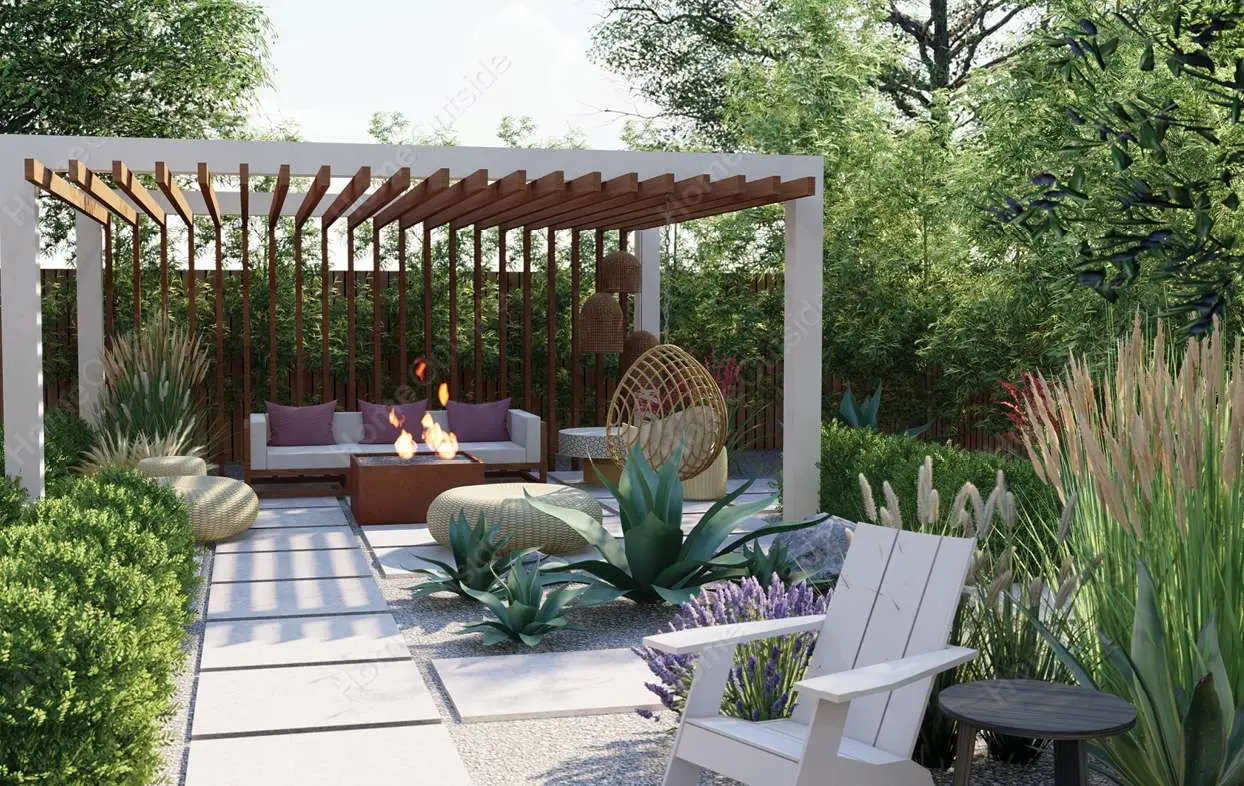
A modern pergola usually has slim, flat-roofed lines, hidden gutters and a single colour across frame and roof. Anthracite grey, white and wood-effect finishes are popular because they match contemporary villa facades. An architectural or contemporary pergola design works best when its colour and roof line follow the windows and roof of the house, so it looks planned with the villa and not added on.
These ideas suit Dubai homes well:
- Pergola with sliding screens: vertical slats or blinds on the sunny side, which also give privacy.
- Pool pergola: a shaded lounge beside the pool so you can swim and rest without full sun exposure. See our pool landscaping ideas for planting and decking that work around it.
- BBQ pergola: a covered cooking and dining zone. Use a roof that lets heat and smoke escape over the grill, and follow your community's rules on gas. Our outdoor kitchen guide covers layouts and materials.
- Deck and pergola combination: a raised deck under a pergola creates a defined outdoor room. Light-coloured decking stays cooler underfoot.
- Cooling under the roof: ceiling fans or misting systems under a solid or louvred roof make the space usable for longer. Plan the power and water supply before the roof goes on.
Pergola lighting ideas
Good lighting ideas for a pergola turn it into an evening space, which matters in Dubai because evenings are when many people use the garden in summer. Plan the cables before the pergola is built, because hiding them inside beams and posts later is harder.
- LED strips recessed into the beams for soft, even light.
- Downlights in a solid or louvred roof over the dining table.
- Pendants or festoon lights for a relaxed, decorative look.
- Uplights at the base of posts or climbing plants for depth.
Choose warm white light for a relaxed feel, and outdoor-rated fittings that keep out dust and water. For a fuller explanation of IP ratings, colour temperature and avoiding glare, read our garden lighting ideas. NAM Landscaping also offers landscape lighting design.
Rooftop pergola design
A rooftop pergola can turn an unused villa roof or terrace into a shaded seating area. It needs more planning than a garden pergola for three reasons.
- Weight: the roof slab must carry the pergola, furniture, planters and people. A structural engineer should check this.
- Wind: wind is usually stronger at height, so fixings, roof panels and sails must be designed for higher loads.
- Waterproofing: drilling into a roof can damage its waterproofing layer. Use bases that avoid puncturing it, or have any penetrations properly sealed.
If you are planning planting up there too, our guide to vertical and rooftop gardens in Dubai covers soil weight and irrigation.
How to size a pergola
A good pergola design starts with the furniture, not the frame. Lay out the table, chairs or loungers you plan to use, then add space to walk around them and pull chairs back. The shade needs to cover that whole area at the times you will use it.
Remember that shade moves. A pergola that shades a table at noon may leave it in the sun by 5 pm, when the sun drops in the west. Many people make the pergola slightly larger on the west side, or add a screen or blind there.
Keep the roof high enough to feel open and to let hot air rise away from you, and check that doors, windows and any air-conditioning units are not blocked. For a ground surface under the pergola, see our patio and paving ideas.
What does a pergola cost in Dubai?
Cost depends mainly on size, material, roof type and extras such as lighting, screens, fans or motorised louvres. NAM Landscaping's published starting price for pergolas is from AED 650 per m². This is an indicative starting price, confirmed in writing after a free site visit.
As a worked example, a 4 m by 4 m pergola covers 16 m². At the starting rate of AED 650 per m², that gives a starting point of about AED 10,400 before options. A louvred roof, built-in lighting or side screens would add to that figure.
For an affordable pergola, keep the frame simple, choose a fixed roof over a motorised one and size it to your real furniture. You can add shade sails, blinds or lighting later.
Approvals: getting a community NOC
In many Dubai villa communities you need permission before building a pergola. Developers usually ask for a no-objection certificate (NOC), which is written approval from the community, before any change to the villa's exterior. Emaar told Gulf News in 2018 that home improvements need the community manager's consent, and significant ones also need Dubai Municipality approval. Some communities also set rules on materials, colours and size.
Rules change and differ between communities, so follow these steps before any work starts:
- Ask your community manager or developer for the current modification guidelines and pergola conditions.
- Prepare drawings showing size, height, position, material and colour. For an attached pergola, the plan should also show how it connects to the house wall and where rainwater drains.
- Submit the NOC application and wait for written approval.
- Confirm whether Dubai Municipality or another authority also needs to approve the structure.
- Keep the approval documents, as they may be requested when you sell or rent the villa.
Pergolas are not car parking shades
Car parking shades are a different kind of structure, usually tensioned fabric or metal over a driveway, so they are not covered here. This guide covers pergolas and shade for living spaces only, and NAM Landscaping does not build car parking shades.
If you want help choosing a material, roof and layout for your garden, terrace or pool area, see the options on our pergola and shade structures page.