The best garden designs for a Dubai villa give you shade, use plants that tolerate heat, keep lawn to the areas you really use, and water through drip irrigation. Style comes second: modern, Arabian courtyard, Mediterranean, tropical and desert gardens can all work if they follow those four rules.
These garden and landscaping ideas cover six styles, the rules behind a house landscape design that survives summer, layouts for small and large plots, planting, walls and outdoor living areas, and how a project runs.
Why Dubai gardens need different design rules
Heat decides what survives. The UAE's hottest and driest stretch, known as Jamrat Al Qayth, runs from 3 July to 10 August according to the Emirates Astronomical Society, and a Dubai forecast issued a few days into that period gave temperatures between 33°C and 42°C with humidity from 20 to 60 per cent (Khaleej Times weather report, July 2026). A design copied from a cooler country can fail here within one summer.
Three other local conditions shape the plan. Dust and sandstorms settle on leaves and furniture, hard water leaves mineral marks on glass and stone, and coastal humidity makes hot days feel heavier. Good design answers each one with shade for people, tough plants, easy-clean surfaces and efficient watering.
Six garden styles and landscaping ideas for Dubai villas
Pick a style by how you want to use the garden and how much upkeep you accept. The table gives a quick comparison, and the sections after it explain each one.
| Style | Look | Upkeep | Best for |
|---|---|---|---|
| Modern or contemporary | Clean lines, paving, a few plant types | Low to medium | Entertaining, new-build villas |
| Arabian courtyard | Enclosed, patterned paving, a central water feature | Medium | Privacy, a traditional feel |
| Mediterranean | Warm stone, terracotta, gravel, olive-type planting | Medium | Relaxed family dining |
| Tropical | Lush layers, large leaves, palms | High | Pool surrounds |
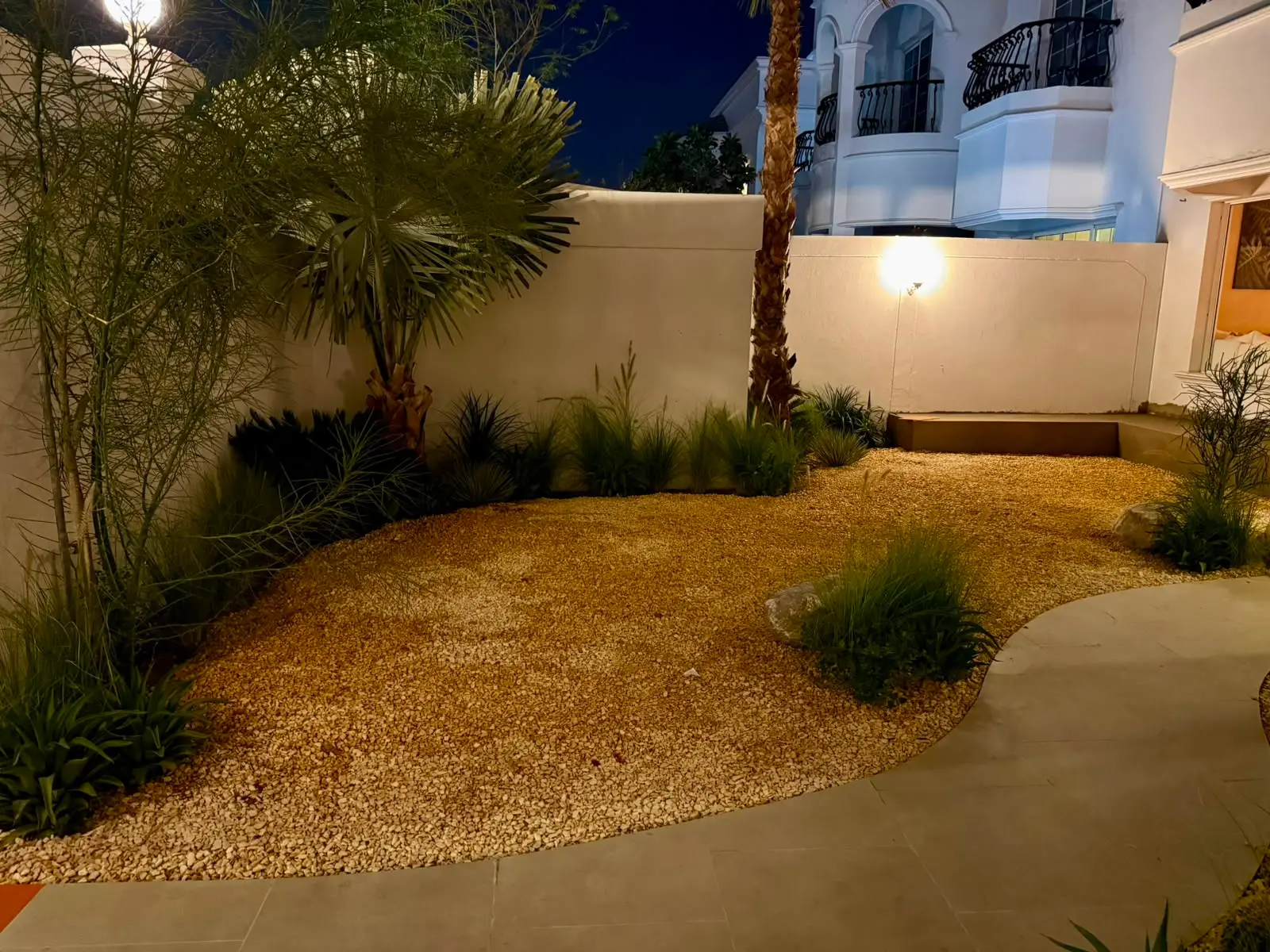
| Desert or xeriscape | Gravel, boulders, succulents, drought-tolerant trees | Low | Lowest water use |
| Zen or minimalist | Raked gravel, stones, a few sculpted plants | Low | Quiet corners, small plots |
Modern and contemporary gardens
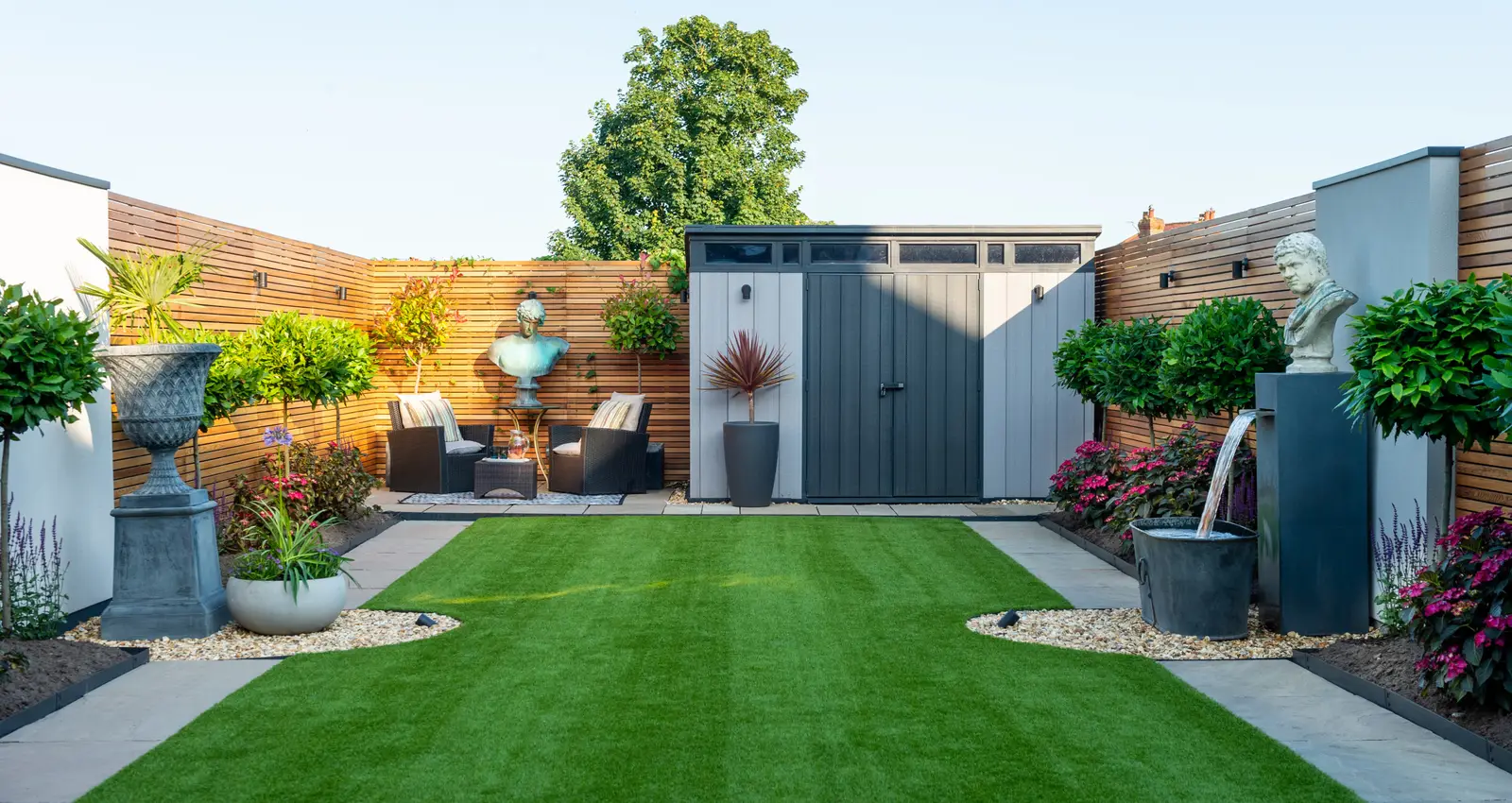
Modern garden design uses straight lines, geometric beds and a short list of materials. Contemporary gardens follow current trends and are usually a little softer, with curves or looser planting beside the hard edges.
This style suits Dubai because large paved areas and clipped planting are easy to keep clean after a dust storm. The risk is heat: pale stone reflects light and bare paving gets very hot, so add shade and plant a few trees. Our guide to patio and paving ideas covers material choices.
Arabian courtyard gardens
An Arabian courtyard is an enclosed garden built around a central point, often a fountain or small pool, with patterned tiles and plants in pots or narrow beds. Walls and shaded corners keep the space cooler and private.
Moving water adds a calming sound, though it also needs a pump and regular cleaning. This style works well on villa plots where privacy matters more than lawn space.
Mediterranean gardens
Mediterranean gardens use warm stone, terracotta pots, gravel paths and plants that cope with dry summers. The look is relaxed and works well around a dining table under a pergola.
Many plants used in this style prefer less humidity than the coast gives, so choose carefully and test a few varieties before planting the whole garden.
Tropical gardens
Tropical design layers palms, large-leaf plants and flowering shrubs for a lush, green look, which is why it is popular around pools. It also usually needs the most water of the six styles, because lush plants need more water and more frequent care in Dubai heat.
If you like the look, limit it to one area, such as the pool edge, and use tougher plants elsewhere.
Desert and xeriscape gardens
Xeriscape means designing a landscape to need very little irrigation. Colorado State University's PlantTalk guidance sets out the sequence: plan the design first, improve the soil, choose low-water plants, match watering to each plant's needs, use alternatives to grass such as mulch, paths or decks, and mulch to reduce evaporation (CSU PlantTalk xeriscape basics). The advice comes from Colorado, but the logic applies in any dry climate.
In Dubai, a desert garden can use gravel, boulders, succulents such as agave, and native trees. The ghaf, the UAE's national tree, is described by the Environment Agency Abu Dhabi as drought-tolerant and able to stay green in harsh desert conditions (EAD ghaf tree profile). See desert plants and trees for the UAE for more options.
Zen and minimalist gardens
Zen garden ideas centre on raked gravel, a few carefully placed stones and one or two sculpted plants. Because there is little to water, this style is low in upkeep, and it suits a quiet corner or a small courtyard.
The design principles that matter most in Dubai
Work through these five principles in order, because each one affects the next.
- Shade first. Decide where you will sit and put shade there before choosing plants. A pergola or shade structure and a few trees let you use the garden for more months of the year. See pergola and shade ideas for options.
- Zone the garden. Divide the plot into areas: seating, play, planting, service. Zones keep the layout clear and let you water each plant group separately.
- Group plants by water need. Plants with similar needs share a watering zone, so thirsty plants do not drown dry-climate ones. Matching watering to plant needs is also a core xeriscape habit.
- Use the right amount of lawn. A lawn is a good play surface but usually uses the most water, so lawn and irrigation choices show up on your DEWA water bill. Keep it to the area you actually use, and read best grass for Dubai lawns before choosing a type.
- Plan water and lighting early. Pipes and cables are far cheaper to place before paving goes down. Our irrigation guide and garden lighting ideas explain what to plan.
Garden arrangements and layouts for a villa plot
A layout is the plan that decides where each zone goes. Start with the sun path and the views from inside the house, then place the main seating area where you will use it most in the evening.
Front, side and back
The front garden is about welcome and kerb appeal, the back is for living, and side passages are often used for services or a narrow green screen. We cover the front in front yard and villa entrance ideas and the back in backyard landscaping ideas for Dubai.
Two-level and tiered gardens
If your plot has a slope or you want visual interest, a two-level or tiered garden uses retaining walls to create terraces. Terraces can separate a dining level from a lawn level, and walls double as seating. They need proper drainage behind the wall, so plan them with a designer rather than adding them later.
Simple, easy garden layouts for small plots
For compact spaces, keep the design to one seating area, one border and one focal point. A simple landscape design repeats a few plants and finishes, which makes easy landscaping possible: fewer plant types, one irrigation zone per planting group and paths wide enough to maintain.
Small garden ideas for Dubai goes into more detail.
Large plots and acreage
On a large villa plot, the same zoning applies at a bigger scale. Link zones with clear paths, keep formal planting and the main lawn close to the house, and use tougher, low-water planting further out. A large plot also needs more than one irrigation zone and more shade points, so people can reach a cool spot from anywhere in the garden.
Walls and fences as design features
A garden design wall does more than mark the boundary: it gives privacy, shelter from wind and dust, and a backdrop for planting or lighting. Choose finishes that match the house and keep the number of materials low. Boundary walls often need community approval, so check first. Our guide to garden wall and fence ideas covers the options.
Alfresco and outdoor living areas
Alfresco garden ideas start with a shaded dining or lounge area close to the kitchen door, so food and drinks do not travel far in the heat. Add seating along a wall or border, and consider an outdoor kitchen if you entertain often. See outdoor kitchen ideas for Dubai for layouts and what to plan early.
Flower bed design, planters and garden decor
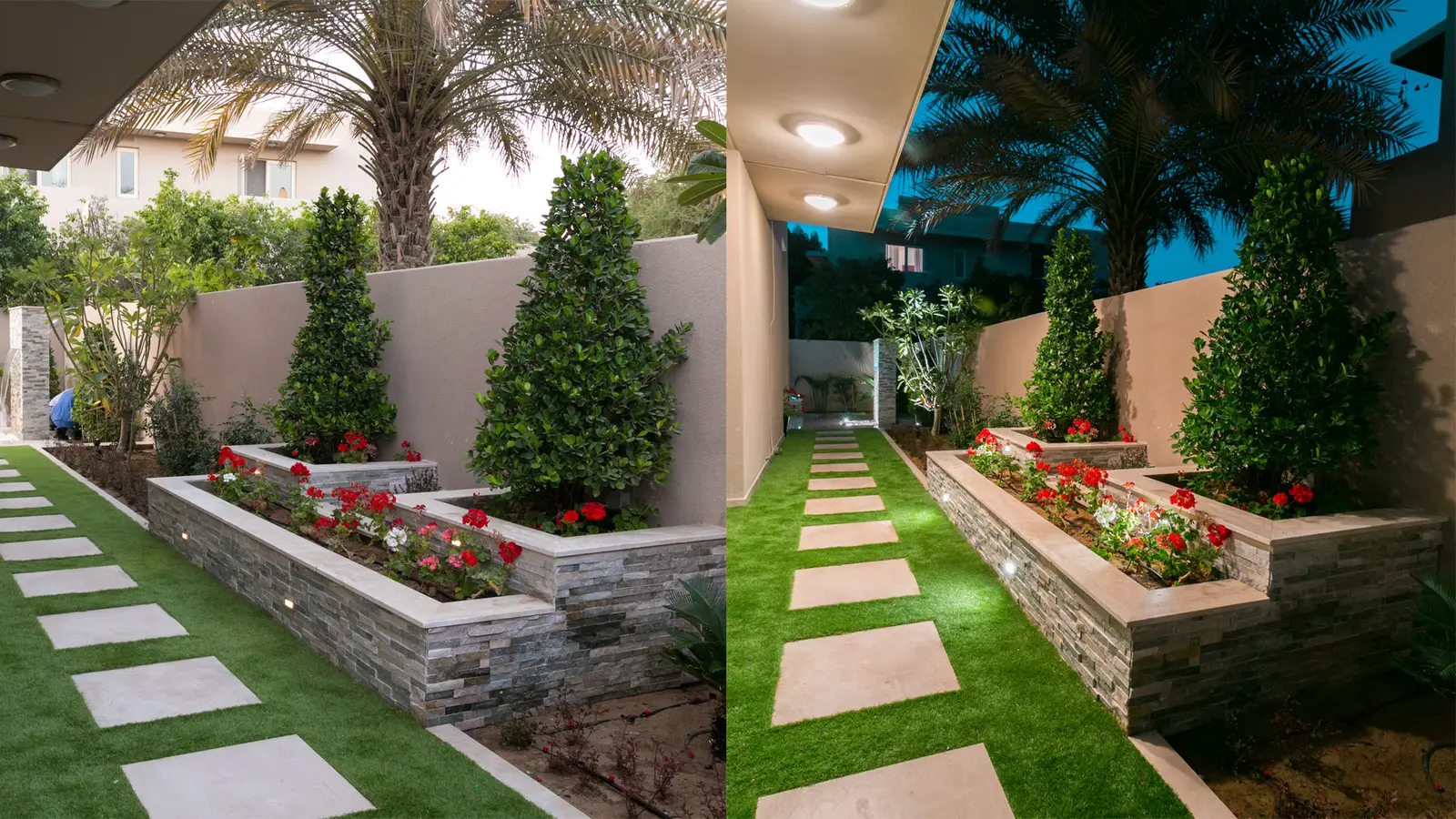
Flower bed design works best when beds are wide enough for layered planting, with taller plants at the back and low plants at the front. Edge beds with stone or steel so soil and mulch stay in place, and cover the soil with mulch to cut evaporation.
For planters, drainage matters more than material. Choose pots and planter boxes with drainage holes, because standing water rots roots. Terracotta is porous and tends to dry faster, so it suits drought-tolerant plants. Dark containers in direct sun can run much hotter than the air and stress roots, so lighter colours or thicker walls are safer (NC State Extension on hot pots).
For decor, a few strong pieces beat many small ones: a large pot, a bench, a sculpture or a feature wall. A hardscaping upgrade such as a feature wall or seating area gives the garden structure that plants alone cannot.
How a garden design project runs
A professional project usually moves through these stages:
- Site visit and survey. The designer measures the plot, notes sun, shade, drainage and existing plants, and asks how you use the space.
- Concept and plan. You receive a garden plan that shows the zones, levels, materials, planting list and irrigation layout. Ask for a 3D visual if you find landscape design plans hard to read.
- Approvals. Check your community guidelines and ask the developer whether your changes need an NOC (no objection certificate). In many villa communities the developer must approve structures and larger works, and the rules differ between communities, so confirm before you commit.
- Quote. You should get a written, itemised quote so you can compare scope and materials.
- Build and plant. Hardscape, irrigation and lighting go in first, then soil, plants and lawn.
NAM Landscaping offers a free site visit and a written, itemised quote before work starts, and handles garden design and build and pool work under one contract. Design and build work starts from AED 120 per m², confirmed in writing after the visit. For wider budget context, see landscaping cost in Dubai.
Common mistakes to avoid in a Dubai garden
- Too much lawn. It is a major water and upkeep cost in most gardens.
- Plants chosen before shade. Trees and structures take time, so plan them first.
- No irrigation plan. Hand watering fails when you travel in summer, which is when plants need water most.
- Too many materials. Two or three paving and wall finishes look better than six.
- Skipping approvals. Work that breaks community guidelines may have to be removed, so check first.